
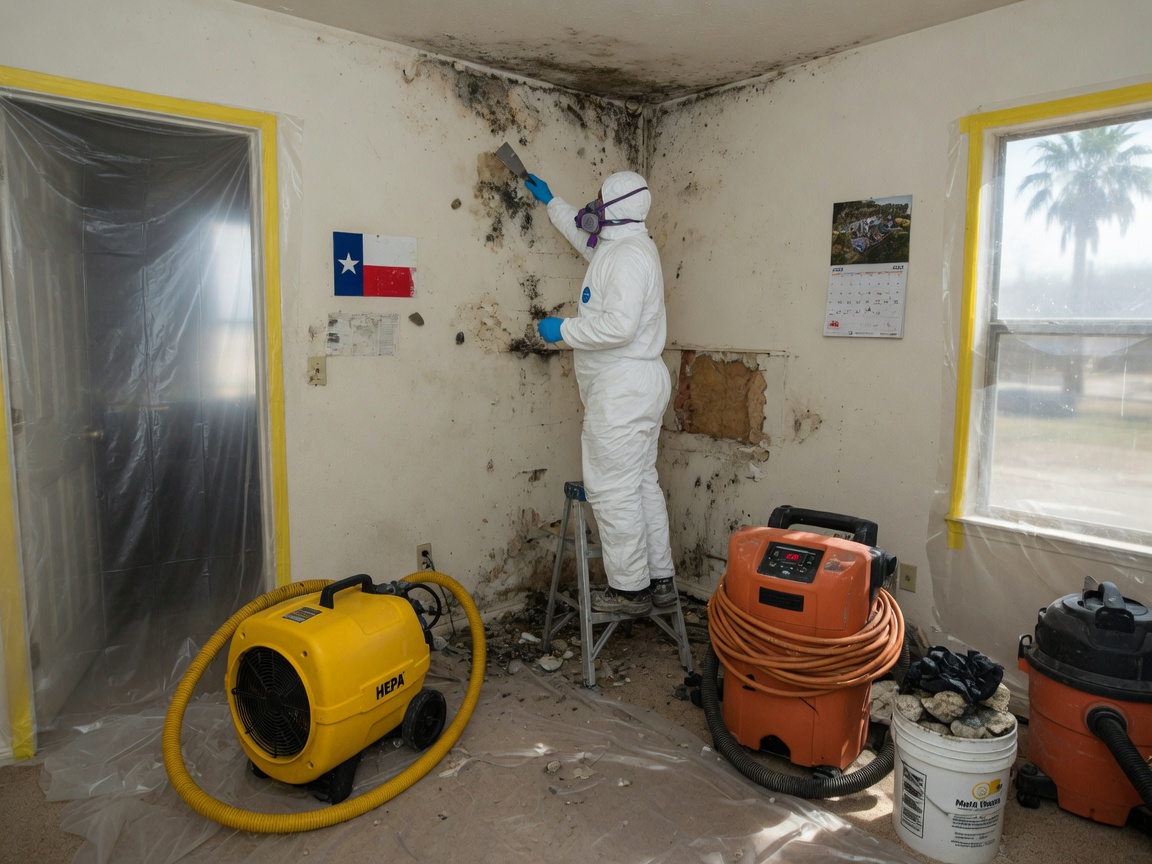
San Antonio summers push indoor humidity high enough to restart growth inside wall cavities of 1920s–1950s homes common in King William and Alamo Heights. Plaster and lathe hold water longer than modern drywall, so visible surface cleaning alone leaves colonies behind the finish. We cut test holes, map moisture with meters, and remove affected material until readings drop below 15 percent before any encapsulation.
Bexar County flood zones near the River Walk and Southtown see repeated saturation from heavy rains that pool against slab foundations. When water sits under tile or carpet, mold travels along subfloors into adjacent rooms. Containment with negative air and sealed poly sheeting prevents spores from reaching HVAC returns that serve the whole house.
Mild winters keep temperatures above freezing, so homeowners often delay drying after small leaks. That delay lets colonies establish in attics and crawl spaces where ventilation is poor. We combine HEPA vacuuming, antimicrobial application on joists, and dehumidification sized for the square footage until the structure passes clearance testing.
Historic districts limit what can be torn out, so we document every step with photos and work with owners to match original materials after removal. This keeps jobs compliant while still reaching hidden growth behind baseboards and in ceiling joists.
Technician insight
In San Antonio the thing that catches most people out with Mold Remediation is how quickly summer humidity restarts growth inside the plaster walls of 1920s homes in King William and Alamo Heights. A small ceiling leak from a rain event can travel along lathe and show up two rooms away weeks later. Homeowners often paint over spots instead of pulling the material, which just traps the moisture and spreads it to the next stud bay.
Hidden Growth Behind Plaster in Southtown
A homeowner in Southtown noticed a musty smell after a June storm. We found elevated moisture behind original plaster in two bedrooms that had traveled from a roof leak. Containment kept spores out of the living areas while we removed the affected sections and ran dehumidifiers for four days. Clearance tests passed and the family moved back in without further odor.
Mold Remediation Services We Offer
✓Black Mold Removal
Full containment and removal of Stachybotrys in wall cavities of older Bexar County homes, followed by HEPA air scrubbing.
✓Attic Mold Remediation
Inspection and treatment of mold on rafters and insulation caused by roof leaks common after San Antonio's summer storms.
✓Crawl Space Mold Treatment
Vapor barrier installation and antimicrobial application to stop growth from ground moisture in Southtown and Downtown properties.
✓Bathroom Mold Remediation
Removal of tile and drywall mold plus exhaust fan upgrades to control humidity in older King William bathrooms.
✓Post-Flood Mold Remediation
Drying and material removal after River Walk area flooding to prevent hidden colonies under flooring.
✓HVAC Mold Cleaning
Duct and coil treatment to stop spores from circulating through homes in Alamo Heights after water intrusion.
Mold Remediation Cost in San Antonio, TX
| Service | Typical Range | What Affects It |
|---|---|---|
| Small bathroom remediation | $800–$1,600 | Includes tile removal and fan upgrade |
| Attic treatment | $1,200–$2,800 | Varies with insulation type and access |
| Crawl space encapsulation | $1,500–$3,500 | Includes vapor barrier and dehumidifier install |
| Whole-room wall cavity work | $2,000–$4,500 | Higher in historic plaster homes |
Ranges are typical for San Antonio, TX and confirmed with an exact written quote before any work starts.
How it works
- 1
Moisture Mapping
We use meters and infrared cameras to locate hidden water in walls and floors of San Antonio homes.
- 2
Containment Setup
Negative air machines and sealed barriers isolate the work area to protect the rest of the house.
- 3
Material Removal
Affected drywall, insulation, and wood are cut out and bagged for disposal.
- 4
Drying and Treatment
Commercial dehumidifiers and air movers run until moisture levels are safe, then antimicrobials are applied.
- 5
Clearance Testing
Independent air samples confirm the space meets post-remediation standards before rebuild.
Pricing
Cost depends on square footage, hidden damage, and whether contents must be moved.